The Rise of the Cordless Impact Wrench
In past decades, heavy machinery maintenance and the automotive industry were dominated by heavy, restricted pneumatic tools. However, with breakthroughs in lithium-ion battery technology and motor efficiency, the Cordless Impact Wrench has evolved from a "convenient alternative" into a "performance master."
The core value of the Cordless Impact Wrench lies in its complete elimination of the air hose connection to a compressor. This portability means you can easily remove a tire during a roadside emergency and ensures that on complex factory structures or construction sites, operators are no longer hindered by tangled cables or hoses. The torque output of modern high-performance Cordless Impact Wrench models has long surpassed the 1,000 Nm mark, making them capable of handling the most rusted and seized industrial bolts.
Internal Working Principle: Why the Cordless Impact Wrench is So Powerful
How can a small Cordless Impact Wrench explode with dozens of times more torque than a standard drill? This stems from its unique physical striking mechanism.
Striking Mechanism: Hammer and Anvil
Unlike the continuous rotation of a regular drill, the Cordless Impact Wrench contains a complex "impact mechanism." As the motor rotates, it compresses a powerful internal spring, driving a rotating hammer to accumulate kinetic energy. When the spring releases, the hammer instantly strikes the anvil at the output end.
This instantaneous mechanical collision generates a high-energy pulse of torque, similar to hitting a wrench handle with a heavy sledgehammer. Because this force is delivered in bursts, it effectively breaks the rust and friction between threads without generating the massive reactionary force that twists the operator's wrist.
Technical Advantages of Brushless Motors
In modern Cordless Impact Wrench design, the brushless motor has become standard for high-end models. Compared to traditional brushed motors, it eliminates carbon brush friction, reducing energy loss to a minimum. Below is a core parameter comparison for a Cordless Impact Wrench under two motor configurations:
| Performance Parameter |
Brushed Motor |
Brushless Motor |
| Energy Conversion Efficiency |
Approx. 70% - 75% |
Approx. 85% - 95% |
| Motor Lifespan |
Medium (Brushes need replacement) |
Extremely Long (No mechanical wear) |
| Heat Dissipation |
Prone to heating; needs ventilation |
Stable operation; very low heat |
| Intelligent Adjustment |
None |
Supports electronic torque feedback |
| Battery Life per Charge |
Standard |
Increased by approx. 30% - 50% |
Performance Duel: Cordless Impact Wrench vs. Pneumatic and Corded Models
For professional users, choosing between a Cordless Impact Wrench and a pneumatic impact wrench often depends on the working environment.
Core Parameter Comparison Table
| Dimension |
Cordless Impact Wrench |
Pneumatic Impact Wrench |
| Flexibility |
Extremely high; no space/power limits |
Low; limited by air hose length |
| Torque Consistency |
May fluctuate slightly as battery drops |
Constant torque with stable air pressure |
| Maintenance |
Very low (Battery care only) |
High (Requires oiling, draining, compressor care) |
| Noise Level |
Medium (Motor + striking sound) |
High (Exhaust + striking sound) |
| Initial Investment |
Higher (Includes battery/charger) |
Lower (But compressor systems are expensive) |
Five Core Indicators for Selecting a Cordless Impact Wrench
Choosing the right Cordless Impact Wrench isn't just about finding the highest torque; it requires a balance between power, portability, and the battery system based on actual application scenarios.
Drive Size and Torque Rating
The drive square size of a Cordless Impact Wrench directly determines the maximum force it can carry. Generally, the larger the size, the heavier the internal striking mechanism and the higher the output torque.
| Drive Size |
Typical Torque Range |
Core Application Scenarios |
| 1/4" (6.35mm) |
100 - 200 Nm |
Lightweight assembly, precision repair, tight spaces. |
| 3/8" (9.5mm) |
300 - 700 Nm |
Engine repair, chassis components, motorcycle maintenance. |
| 1/2" (12.7mm) |
600 - 1600 Nm |
Mainstream Spec. Tire changes, heavy suspension, construction. |
| 3/4" & 1" |
Over 2000 Nm |
Heavy trucks, agricultural machinery, industrial installation. |
Fastening Torque vs. Nut-Busting Torque
When checking Cordless Impact Wrench specifications, you will usually see two values.
- Fastening Torque: The force the tool can achieve when tightening a bolt.
- Nut-Busting Torque: Also known as breakaway torque. Because removing rusted or over-tightened bolts requires an instant burst of power, the nut-busting torque of a Cordless Impact Wrench is usually 30% - 50% higher than its fastening torque.
Battery Platform and Voltage
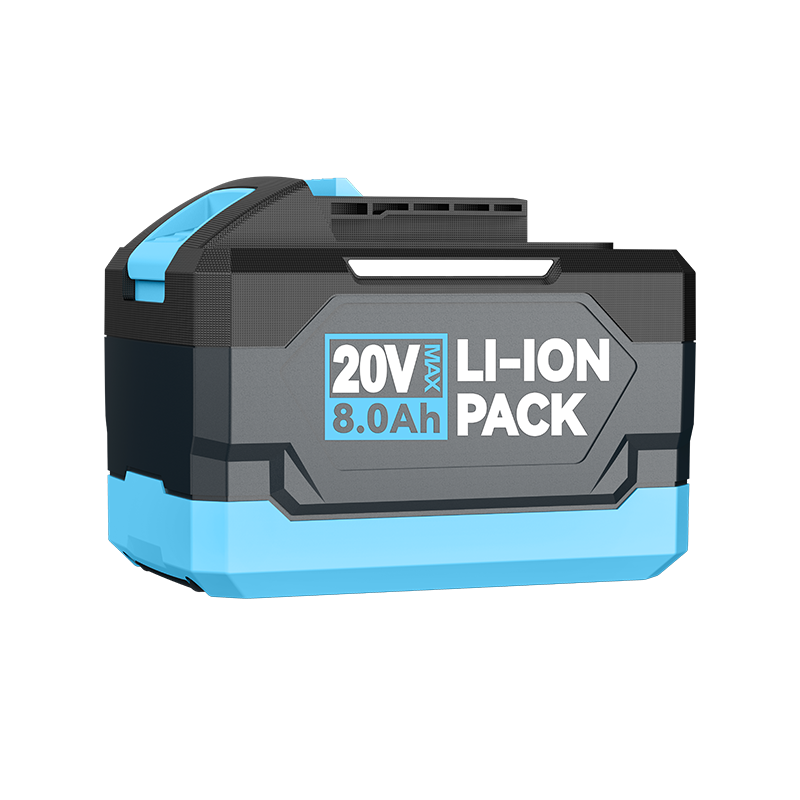
The battery is the heart of the Cordless Impact Wrench. The current market is divided into three voltage levels:
- 12V Systems: For ultimate lightness, suitable for overhead work, but with limited torque.
- 18V / 20V Systems: The industrial standard. Provides the power needed for most tasks via brushless motors and high-rate lithium batteries.
- 40V / 60V Systems: For extreme heavy-duty tasks. High voltage means lower current, effectively reducing heat during continuous high-load use of the Cordless Impact Wrench.
Intelligent Control and Auto-Stop Mode
Modern Cordless Impact Wrench models are no longer just "brute force" tools. High-end models feature electronic control panels:
- Multi-speed Regulation: Allows users to adjust output based on bolt size to prevent snapping small bolts.
- Bolt Removal Auto-Mode: When the Cordless Impact Wrench senses the nut is loose, it automatically slows down or stops rotation.
- Tightening Protection: Stops instantly after the bolt hits the surface, allowing for manual precision torque checking later.
Weight and Ergonomics
Since a Cordless Impact Wrench carries a heavy striking mechanism and battery, weight usually ranges from 1.5kg to 4kg.
- Balance: A good Cordless Impact Wrench is designed with the center of gravity at the handle to avoid being "top-heavy."
- Vibration Reduction: Internal rubber damping rings absorb high-frequency vibrations to protect the operator's wrists.
Professional Maintenance for Extending Cordless Impact Wrench Life
Lubrication of the Striking Mechanism
The core of the Cordless Impact Wrench is the high-frequency collision between the hammer and anvil. Over time, internal grease can dissipate or degrade due to centrifugal force.
- Regular Greasing: For professional models used frequently, it is recommended to disassemble the front housing every six months to clean and replace the specialized impact mechanism grease.
- Dry Friction Prevention: Lack of lubrication leads to abnormal heat in the Cordless Impact Wrench and can cause the anvil to shatter.
Lithium Battery Health Rules
Batteries are the power source, and improper use is the main cause of premature failure.
| Maintenance Dimension |
Recommended Action |
Forbidden Behavior |
| Storage Temp |
15°C - 25°C (Cool and dry) |
Leaving in hot cars or damp basements |
| Charge Level |
Keep at 30% - 50% for long storage |
Storing at 0% for long periods |
| Charging Timing |
Charge when power starts to weaken |
Running the battery to absolute empty |
| Cleaning |
Clean contacts with a dry cloth |
Using wet cloths or corrosive solvents |
FAQ: Cordless Impact Wrench Knowledge and Common Questions
Q1: Why must I use "Impact Sockets" with a Cordless Impact Wrench?
Regular manual sockets (Chrome Vanadium) are hard but brittle. Under the thousands of violent blows per minute from a Cordless Impact Wrench, they can easily shatter. Impact sockets are made of Chrome Molybdenum (Cr-Mo), which has higher toughness to absorb the impact, making them a mandatory safety requirement for any Cordless Impact Wrench.
Q2: Can I use a Cordless Impact Wrench for drilling?
While adapters exist, it is strongly discouraged. The mechanical nature of the tool provides rotational pulses rather than smooth speed. This can cause drill bits to snap and results in extremely low precision, potentially damaging the bearings of the Cordless Impact Wrench.
Q3: How do I distinguish between an Impact Wrench and an Impact Driver?
| Feature |
Cordless Impact Wrench |
Impact Driver |
| Output Interface |
Square Drive (1/2", 3/8", etc.) |
1/4" Hex Quick-change Chuck |
| Main Target |
Nuts, hex bolts, heavy anchors |
Wood screws, self-tapping screws |
| Torque Level |
Extremely high (up to 1000Nm+) |
Lower (usually 150-220Nm) |
Q4: Is it dangerous to use in rainy or damp environments?
Most professional Cordless Impact Wrench models have basic dust and water resistance, but they are not waterproof. Dampness accelerates internal corrosion. If the tool gets wet, remove the battery and let it air dry completely before use.
Q5: Why can't my 800Nm tool remove a rusted lug nut?
Rusted bolts often have an "initial friction" far higher than their theoretical torque. When using a Cordless Impact Wrench in this situation, apply penetrating oil first. If the nut does not move after 5 seconds of continuous impacting, stop. Use a manual breaker bar to loosen it one turn first to protect the Cordless Impact Wrench motor.

 English
 русский
 Español