2026-08-24
You are standing in front of a row of cordless tools, both labeled “impact,” both roughly the same shape, and both far too similar in your mind. One is an impact driver. The other is an impact wrench. They share a common technology, but they are engineered for completely different tasks. Pick the wrong one, and you’ll waste money, damage fasteners, or even put yourself at risk.
This guide gives you the direct answer: an impact driver is a high-speed screw-driving specialist, while an impact wrench is a high-torque bolt and nut specialist. We’ll cover how each works, the seven key differences, whether you can swap one for the other, and a practical framework for choosing the right tool for your projects. For a side-by-side reference, see our detailed impact wrench vs. impact driver comparison.
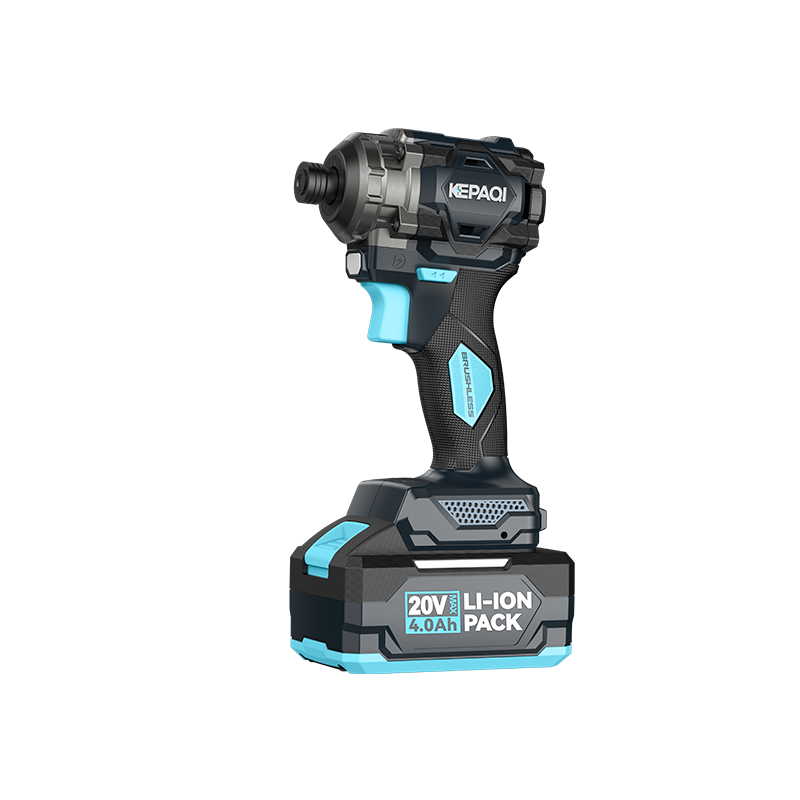
An impact driver is a compact power tool designed to drive screws and small fasteners quickly and efficiently. It uses a spring-loaded hammer that delivers rapid rotational impacts, allowing you to drive long screws without stripping the head. A typical impact driver has a 1/4-inch hex quick-change chuck, produces around 100 to 200 N·m of torque, and spins at 2,000 to 3,600 RPM. In practical terms, it is a supercharged screwdriver with an internal hammer system that prevents the bit from camming out.
Inside an impact driver, the motor rotates a spring-loaded hammer. As the hammer spins, it slides past an anvil, then snaps back and strikes it with a sharp rotational blow. This happens dozens of times per second. The force is applied in the direction of rotation, not along the axis of the tool, which means the tool pushes forward while delivering intermittent rotational energy. That combination keeps the screw sinking even when resistance spikes.
Because impact drivers are light and compact, they are easy to use overhead or in tight corners. The impact action reduces the twisting reaction that travels through your wrist, so you can work longer without fatigue.
An impact wrench is a heavier, more powerful tool built to loosen and tighten nuts and bolts under high torque. Instead of a hex chuck, it uses a 3/8-inch, 1/2-inch, or 3/4-inch square drive that accepts impact sockets. Torque ratings typically start around 300 N·m and can exceed 1,500 N·m, while speeds usually stay below 2,000 RPM. The design goal is not speed; it is raw twisting force delivered in short, powerful bursts.
The hammer-and-anvil mechanism in an impact wrench is larger and heavier than the one in an impact driver. A stronger spring and a heavier hammer store more kinetic energy, so each strike transfers a much larger rotational impulse. That is why an impact wrench can break loose rusted, corroded, or overtightened fasteners that would stall an impact driver. Brushless motors add another advantage here, delivering more consistent torque and less heat buildup under continuous load. For a deeper technical explanation, you can read our closer look at how brushless impact wrenches operate.
For heavy-duty jobs such as suspension bolts and truck lug nuts, high-torque cordless impact wrench models like this 1000 N·m unit are the difference between a quick, clean removal and a long, frustrating struggle with a breaker bar.
Both tools use impact technology, but every practical specification differs. The table below gives you the full picture at a glance.
| Aspect | Impact Driver | Impact Wrench |
|---|---|---|
| Drive type | 1/4-inch hex | 3/8 or 1/2-inch square |
| Typical torque | 100–200 N·m | 300–1,500+ N·m |
| Speed (RPM) | 2,000–3,600 | Under 2,000 |
| Size and weight | Compact and light | Bulkier and heavier |
| Accessories | Screwdriver bits | Impact sockets |
| Best for | Screws and light fastening | Bolts and heavy fastening |
| Price range | Generally lower | Generally higher |
The most obvious difference is the connection point. An impact driver uses a 1/4-inch hex collet that holds standard screwdriver bits. An impact wrench has a square-drive anvil, usually 3/8 or 1/2 inch, that connects directly to impact sockets. You cannot fit a socket onto an impact driver without an adapter, and you cannot drive screws with an impact wrench without special adapters. The right tool needs the right interface.
Torque numbers show the real gap. Impact drivers typically deliver 100 to 200 N·m, which is plenty for screws. Impact wrenches start around 300 N·m and climb to 1,500 N·m or more. This difference comes from the larger hammer, heavier anvil, and stronger spring inside the wrench. The extra mass means each impact carries significantly more energy, allowing the wrench to twist off bolts that a driver would simply hammer against without moving.
Impact drivers spin faster, often reaching 3,600 RPM, to drive screws quickly. Impact wrenches run slower, typically below 2,000 RPM, because their priority is high torque rather than rapid rotation. Some models offer adjustable speed modes so you can control output more precisely. For example, two-speed brushless impact wrenches for versatile fastening tasks let you dial down the power for smaller bolts and dial it up when you need maximum breakaway torque.
Impact drivers are compact, usually around 1 to 1.5 kilograms, and easy to maneuver in tight spaces. Impact wrenches are heavier and bulkier because of the larger hammer case and stronger drivetrain. The extra weight is not a negative; it helps dampen vibration and gives the tool momentum when delivering heavy impacts. But for overhead work or extended use, the lighter driver is noticeably friendlier.
Impact drivers use screwdriver bits: Phillips, Torx, hex, and square-drive bits. Impact wrenches use impact sockets in standard sizes such as 10 mm, 13 mm, 17 mm, 19 mm, 21 mm, and 1/2-inch or 3/4-inch drives. Never use regular chrome sockets on an impact wrench; they can shatter under impact loads. Always choose impact-rated sockets designed to absorb the shock.
The clearest practical difference is the material and fastener size. Impact drivers dominate wood-framing, drywall, cabinet installation, deck building, and light metal fabrication. Impact wrenches are essential for automotive repair, equipment maintenance, steel erection, and any job involving nuts and bolts larger than about 10 mm. The division is not absolute, but it is a reliable guide.
For similar battery platforms and brand tiers, impact drivers tend to cost less than impact wrenches. High-torque brushless impact wrenches command a premium because of the larger motor, heavier impact mechanism, and advanced electronic controls. Price alone should not drive your decision. A cheap wrench that cannot handle your fasteners is worse than a mid-range driver that does exactly what you need.
The short answer is: only in light, occasional situations, and not as a regular practice. You can buy a 1/4-inch hex-to-square-drive adapter and connect impact sockets to an impact driver, but the driver simply does not have enough torque for most wheel lug nuts, suspension bolts, or rusted fasteners. The adapter also adds length, reduces the energy transferred to the fastener, and increases the risk of the adapter slipping or breaking.
There is also a safety element. When an impact tool suddenly applies high torque, a non-impact socket or a low-quality adapter can crack and send metal fragments into the air. This risk is why manufacturers insist on impact-rated accessories. If your vehicle is a small sedan, the lug nuts were torqued correctly, and the bolts are not corroded, a fully charged impact driver might just break them free. But on a truck, an SUV, or any vehicle that was serviced with an air wrench, you are likely to stall the driver or damage the adapter.
The same logic applies in other settings. For light steel brackets or M6/M8 bolts, an impact driver with an adapter works intermittently. For anything structural, automotive, or load-bearing, use an impact wrench. If you work on vehicles more than once a month, an impact wrench is not a luxury; it is the correct tool.
Start by looking at the fasteners you handle most often. Screws and small bolts point toward an impact driver. Large nuts, rusted bolts, and high-torque requirements point toward an impact wrench. The profiles below cover common situations.
Before you buy, run through a quick checklist:
One more consideration: brushless motors. Both tools benefit from brushless technology, which provides more consistent torque, longer runtime, and less heat buildup than brushed motors. If you are comparing similar-priced tools, a brushless motor is usually worth the extra cost because it extends the working life of the tool and maintains performance under heavy load.
Impact drivers and impact wrenches come from the same family, but they are not interchangeable. The impact driver is the high-speed screw expert; the impact wrench is the high-torque bolt expert. To make the right purchase, evaluate your most common tasks, check the torque and drive type, and choose the tool that matches the fasteners you actually handle. If your budget allows, owning both covers almost every fastening job in a home workshop, garage, or professional jobsite. Whichever you choose, use impact-rated accessories and keep your batteries charged — the right tool with a fresh battery is the most reliable partner you can have.
Contact Info
+86-13801463308
+86-13862872268
Nantong,Jiangsu,China

 English
 русский
 Español