Is a Brushless Cordless Drill Worth It? The Verdict First
Put two 20 V two-speed drills side by side, one with a brushed motor and one brushless, and compare what they cost against what they deliver. The brushless version carries a price premium of roughly 40 to 70 percent, holds 50 to 60 N·m at the chuck without fading, and finishes about a quarter more work on a single 2.0 Ah charge. Whether that premium is worth paying depends on three numbers: holes drilled per month, minutes of continuous running per session, and the number of years the tool has to survive.
The short rule we give to anyone weighing the purchase: above roughly 250 drilled holes a month, or any routine that keeps the trigger down for more than 20 minutes at a stretch, a brushless drill repays its extra cost within 12 to 18 months. Below 100 holes a year, it usually does not, and the brushed tool finishes the job with money left in the budget.
Brushless is the better buy when
- Drilling passes 250 holes a month
- Sessions run longer than 20 minutes
- The tool must last 4 years or more
- Battery packs are shared across several tools
- Work happens overhead, in tight corners, or in occupied buildings
Brushed still makes sense when
- Fewer than 100 holes a year
- The drill is a loaner, a site spare, or an apprentice kit
- Four or more working batteries already sit on a brushed platform
- The tool is treated as a consumable on rough ground
- Budget is fixed and torque demand is light
There is a second factor that changes the answer, and it is rarely printed on the box: a brushless drill is not only a motor, it is a motor plus a controller. The controller is now the part that most often decides how long the tool lives. A well-protected controller outlasts any set of carbon brushes. A poorly protected one fails faster than brushes ever did, usually from heat or from dust pulled through the vents.
What Actually Changes Inside the Tool
The difference is mechanical before it is electronic, and understanding it explains every number further down this page.
The brushed motor in plain terms
Two carbon blocks, the brushes, press against a spinning commutator and feed current into the rotor windings. The arrangement is cheap to build and simple to repair, but it depends on sliding contact. That contact creates friction, arcing and carbon dust. Between 25 and 35 percent of the electrical energy never reaches the chuck, and it leaves as heat instead. Brushes wear down somewhere between 150 and 400 running hours depending on load, and when they shorten, performance drops quietly before the tool finally stops.
The brushless motor and its controller
A brushless motor turns the layout inside out. The permanent magnets sit on the rotor, the windings sit on the stator, and nothing touches anything else. Hall sensors report rotor position to an electronic speed controller, which fires the phases in sequence. Efficiency typically lands between 82 and 90 percent. At the same output the motor runs cooler, and there is no brush dust to migrate into the switch, the gearbox or the controller board.
What the electronics add beyond efficiency
The controller is where the practical gains show up. Soft start stops the drill from kicking when the trigger is squeezed. Electronic braking stops the chuck in about a second and a half instead of five. Over-discharge and over-temperature cut-offs protect the pack. Constant-speed regulation holds rpm within roughly 5 percent as load climbs, while a brushed drill sags noticeably the moment a bit bites. On a production line fitting hinges or driving deck screws, that stability is the difference between a consistent result and a rework pile.
Brushed vs Brushless: The Numbers That Matter
Specification sheets list voltage and torque. They rarely list the values that decide whether the tool pays for itself. The comparison below uses typical figures for 20 V two-speed drills in the 40 to 60 N·m class.
Typical values for 20 V two-speed drills in the 40-60 N·m class. Real figures move with cell quality, gear ratio and duty cycle.
| Metric |
Brushed drill |
Brushless drill |
What it changes at the bench |
| Motor efficiency |
65 to 75 percent |
82 to 90 percent |
More of each charge reaches the chuck |
| Work per 2.0 Ah charge |
Baseline, about 78 holes |
About 104 holes |
Roughly 25 extra holes before a swap |
| Brush replacement |
Every 150 to 400 hours |
Not applicable |
No mid-life strip-down on site |
| Realistic daily-use life |
2 to 4 years |
5 to 8 years |
Depends heavily on controller quality |
| Heat at the motor housing |
65 to 75 degrees C under load |
50 to 58 degrees C under load |
Longer sessions before thermal cut-out |
| Torque held under load |
Falls away as load rises |
Within 5 to 10 percent of rating |
Cleaner exit holes in hardwood |
| Bare tool weight |
1.1 to 1.4 kg |
1.0 to 1.3 kg |
Small gain, mostly from a shorter head |
| Noise at the operator |
Higher, brush arcing adds a whine |
3 to 6 dB lower |
Matters in occupied buildings |
| Purchase price |
Baseline |
Plus 40 to 70 percent |
Payback follows usage, not the label |
| Most likely failure point |
Brushes, then switch |
Controller, then switch |
Decides repair cost at year three |
Read the last row carefully before deciding. A brushless drill is more reliable overall, but the part that replaces brushed wear is an electronics board that costs more than a set of brushes. That is why controller protection, not the word brushless on the label, is the single most important buying signal.
The Runtime Math Behind the Price Difference
A 20 V max, 18 V nominal 2.0 Ah pack stores roughly 36 Wh. Under a steady load a brushed drill draws about 300 W to cut at a given rate; a brushless drill reaches the same rate at roughly 235 W. That gap is where the extra holes come from, and it repeats across every pack size in the range.
Holes per charge, 18 mm pine, 6 mm bit, 20 V brushless and brushed drills
Brushed, 2.0 Ah pack 78
Brushless, 2.0 Ah pack 104
Brushed, 4.0 Ah pack 156
Brushless, 4.0 Ah pack 205
The saving is not electricity. Recharging a 36 Wh pack costs well under one cent in most markets, so energy price never enters the decision. What enters is cycle life. A lithium pack is typically rated for 300 to 500 full cycles before capacity drops to about 80 percent. A tool that pulls 28 percent more current per hole shortens every pack on the site by roughly the same margin, and packs are the most expensive consumable in a cordless kit.
Worked example: a crew that drills 8,000 holes a year on 2.0 Ah packs needs about 103 charges with a brushless drill and about 103 charges again with a brushed one, but the brushed tool needs 137. Over three years that is an extra 100 cycles, which is a fifth of a pack's rated life at the lower end of the scale, and closer to a third at the upper end. Add the cost of one brush replacement and the 40 to 70 percent premium narrows quickly.
Torque, Clutch and Chuck: What the Specification Sheet Leaves Out
Torque figures sell drills, but the useful question is what torque is available at the bit under load, not at the motor shaft at peak. In 18 mm pine, a 6 mm pilot hole needs around 8 N·m. A 25 mm flat bit in oak can pull 35 to 45 N·m at the chuck, and a hole saw in the same material pushes past 50 N·m. A brushless drill rated at 55 N·m that holds most of that figure under load behaves like a tool with noticeably more headroom than a brushed drill rated at the same number that fades under pressure.
Why 40 to 60 N·m covers most site and workshop work
Below 40 N·m, hole saws and large auger bits stall. Above 70 N·m, the tool becomes heavier and the reaction torque becomes a wrist risk unless an auxiliary handle is fitted. The 40 to 60 N·m band is the practical centre for cabinet work, decking, framing, hinge fitting and light renovation, which is why most 20 V platform drills sit there. A compact, dual-speed model in that band, such as our compact brushless cordless drill driver, covers daily fitting work without adding weight at the nose.
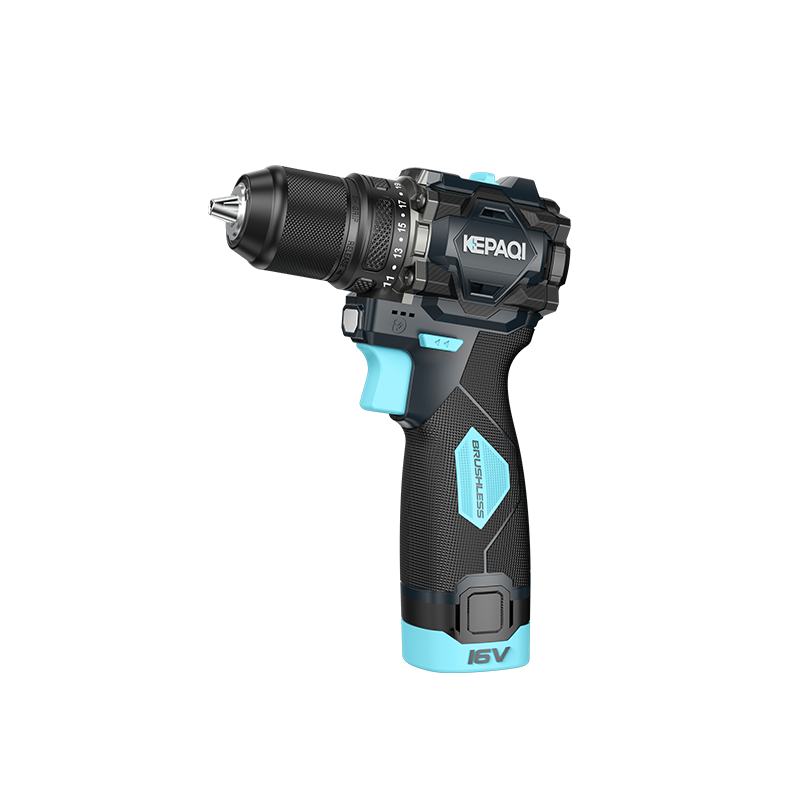
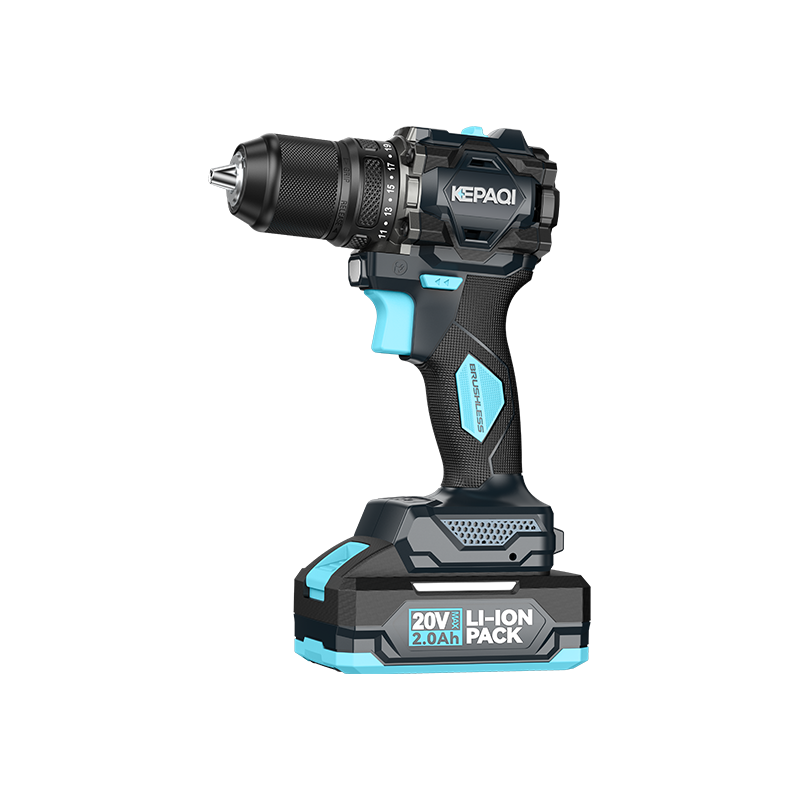
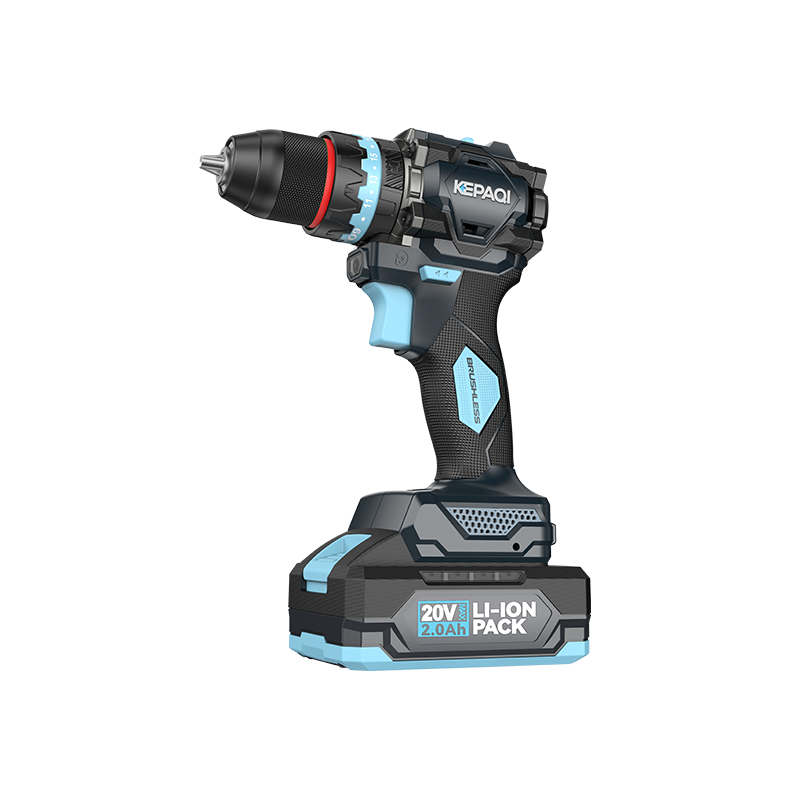 KEPAQI Compact Brushless Dual-Speed Drill DriverA 55 N·m compact 20 V brushless drill with dual speeds, positioned for cabinet work, decking and daily fitting where weight and control matter.View Product →
Clutch settings decide screw quality
An 18-position clutch lets a fitter dial within roughly 0.5 N·m per step; a 24-position clutch narrows that to about 0.35 N·m per step. On softwood this rarely matters. On MDF, laminate or pre-finished panels it is the difference between a consistent countersink and a crushed face. Count the positions and test the lowest three settings before committing a purchase order, since the bottom of the range is where the inconsistency usually appears.
Chuck quality is the quiet failure point
A 13 mm keyless metal chuck should hold runout within 0.1 to 0.3 mm. Plastic-jacketed chucks on low-cost bodies often run out past 0.5 mm, which shows up as a wobbling bit, oversized holes and burned edges in plywood. Spin the chuck with a 6 mm bit fitted before buying. Any visible wobble at the tip is a return, not a tolerance.
Heat, Duty Cycle and Long Sessions
Heat is what kills cordless drills, and the two motor types generate very different amounts of it. A brushed drill running at 300 W of input wastes roughly 90 W inside the housing. A brushless drill producing the same output wastes around 35 W. The visible result is a housing that sits at 65 to 75 degrees C against 50 to 58 degrees C for the same workload.
The practical consequence appears around the 20 to 25 minute mark. Brushed tools reach the thermal cut-out first, or, on cheaper models with no cut-out at all, keep running until the insulation on the windings softens. Brushless tools hold their pace longer and then derate in a controlled way. If a job involves a continuous run of holes, weatherboarding a shed, or drilling a run of studs, that extra thermal headroom is worth more than any single line on the spec sheet. Our own durability benches run tools through repeated load cycles for exactly this reason: the failure appears in the fourth and fifth session, not the first.
Weight, Balance and One-Hand Control
Bare weights in the 1.0 to 1.3 kg range look close on paper, but the number that matters is how the weight sits relative to the grip. A drill with a 165 mm head feels lighter over a ladder than one at 185 mm, because the further the mass sits from the wrist, the more torque the forearm has to fight. For overhead work, 150 g saved at the nose is worth more than 300 g saved in the pack.
Grip circumference should land between 95 and 110 mm for gloved hands, and the rubberised section should sit where the palm contacts the body, not where the fingers wrap. Test the drill with a glove on. A tool that fits a bare hand can still be uncontrollable with a nitrile or leather glove, and that is a common reason for a return after the first site week.
Battery Platform Economics
A brushless drill is only as good as the pack behind it, and the pack is where most of the long-term spend sits. Voltage labels are marketed loosely: a 20 V max platform runs at 18 V nominal, a 21 V max platform at about 18 V nominal as well, and a 16 V platform at 14.4 V nominal. What actually changes runtime is energy in watt-hours, which is ampere-hours multiplied by nominal voltage.
Runtime figures measured in 18 mm pine with a 6 mm bit on a 20 V brushless drill; weight is for the pack alone.
| Pack size |
Energy |
Pack weight |
Holes per charge |
Best use |
| 2.0 Ah |
36 Wh |
About 380 g |
Around 104 |
Overhead work and light fitting |
| 4.0 Ah |
72 Wh |
About 620 g |
Around 205 |
The all-round daily choice |
| 6.0 Ah |
108 Wh |
About 800 g |
Around 300 |
Framing and decking runs |
| 8.0 Ah |
144 Wh |
About 1.0 kg |
Around 400 |
Static bench work, long shifts |
Note the trade-off in the last two rows. Capacity buys runtime, but 1.0 kg hanging off a pistol grip turns a one-handed drill into a two-handed one after five minutes overhead. Most crews run 4.0 Ah packs in the tool and keep one high-capacity pack as a reserve, which is more efficient than fitting the largest pack to every drill.
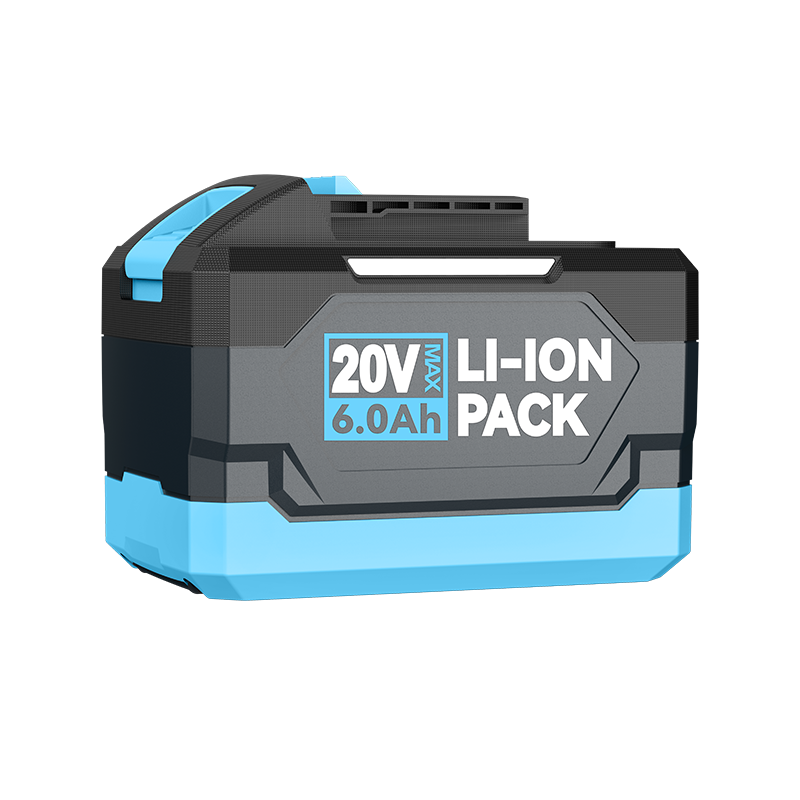
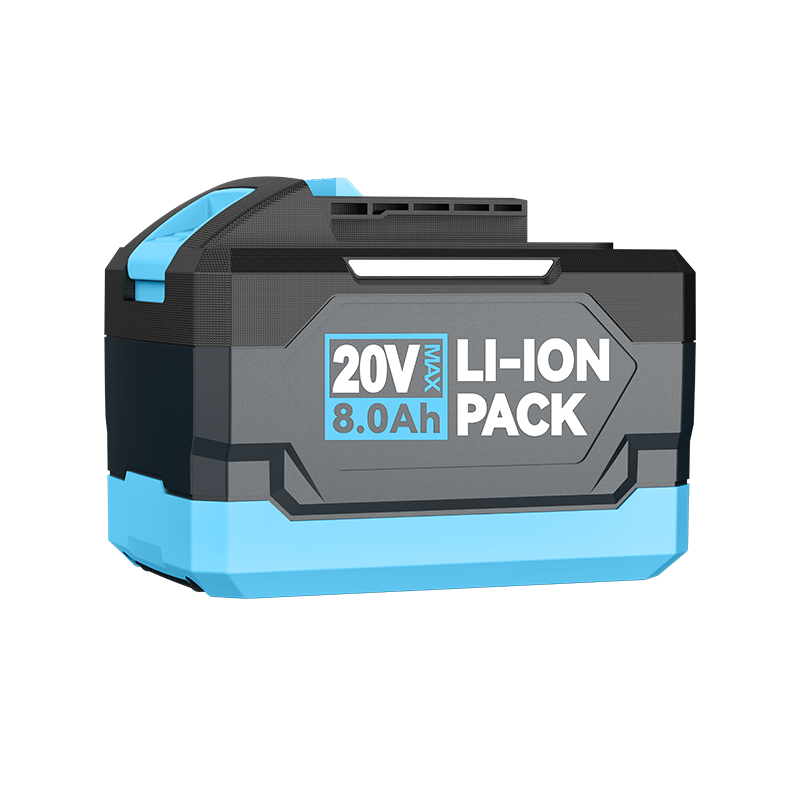 GREAT 8.0AH Battery Pack AccessoryAn 8.0 Ah battery option for crews weighing longer runtime against pack weight, with charger current and storage practice shaping real day-to-day productivity.View Product →
Charger current matters as much as pack size. A 2 A charger refills a 4.0 Ah pack in roughly two and a half hours; a 4 A charger halves that. On a two-battery rotation, the difference between finishing the day on schedule and idling is usually the charger, not the drill. Also check the storage advice: packs kept at 40 to 60 percent state of charge in a cool, dry place lose capacity far more slowly than packs left full in a hot vehicle.
When the Brushed Drill Is Genuinely the Smarter Buy
There is a real case against brushless, and it is not only about price. Four situations stand out.
- Low annual volume. Under 100 holes a year, the efficiency gain never accumulates enough battery cycles to repay the premium.
- Existing platform investment. Four working batteries and two chargers on a brushed platform are worth more than a marginal motor upgrade. Changing platforms costs more than the drill.
- Consumable tools. On rough ground where a drill may be dropped, borrowed or lost, a low-cost brushed unit is easier to write off than a premium one.
- Light, short bursts. Driving twenty cabinet screws a week will not stress either motor, so the thermal and efficiency advantages never come into play.
What does not change with volume is safety and control. If the work involves overhead drilling, careful countersinking, or long continuous runs, the brushless tool is the better choice at any volume, because soft start, braking and stable speed affect the quality of the result from the first hole.
When 20 V Brushless Is Not Enough
A brushless drill is worth it in the 40 to 60 N·m band, but the same logic stops applying once the work moves into masonry and demolition. A 20 V drill in hammer mode produces around 0.5 to 0.8 J of impact energy, which is adequate for 6 mm holes in brick and close to useless in 12 mm concrete. A dedicated SDS-plus rotary hammer delivers 2.0 to 2.8 J and takes the load off the operator's wrist.
Where the torque demand climbs but the format must stay compact, a higher-output cordless drill in the 70 to 90 N·m range makes sense, with an auxiliary handle and a metal gearbox rather than a plastic carrier. Our own heavy-duty brushless cordless drill sits in that band and is built for repeated large-bit work rather than occasional use.
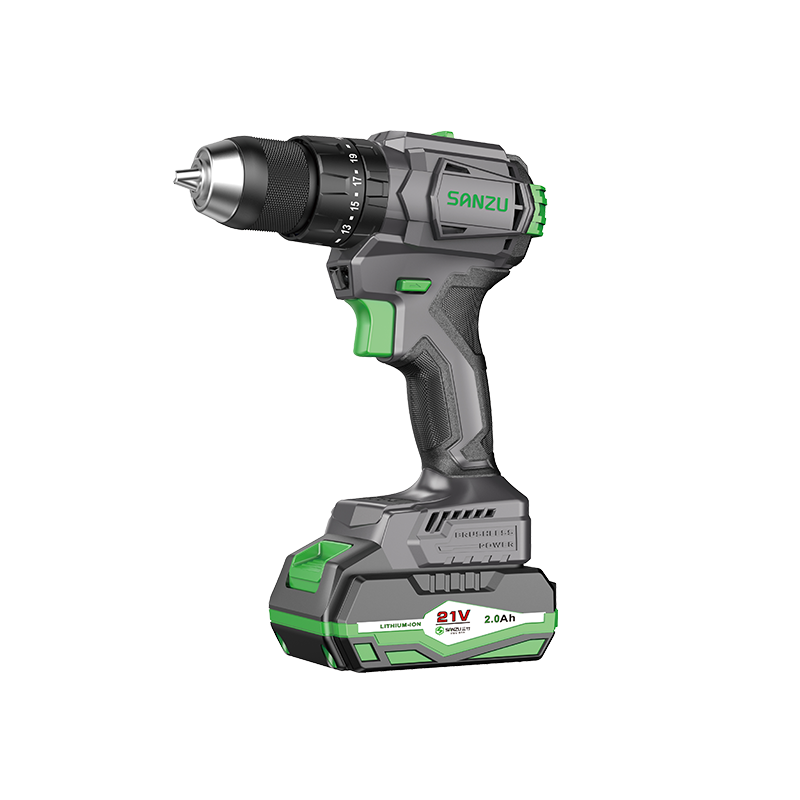
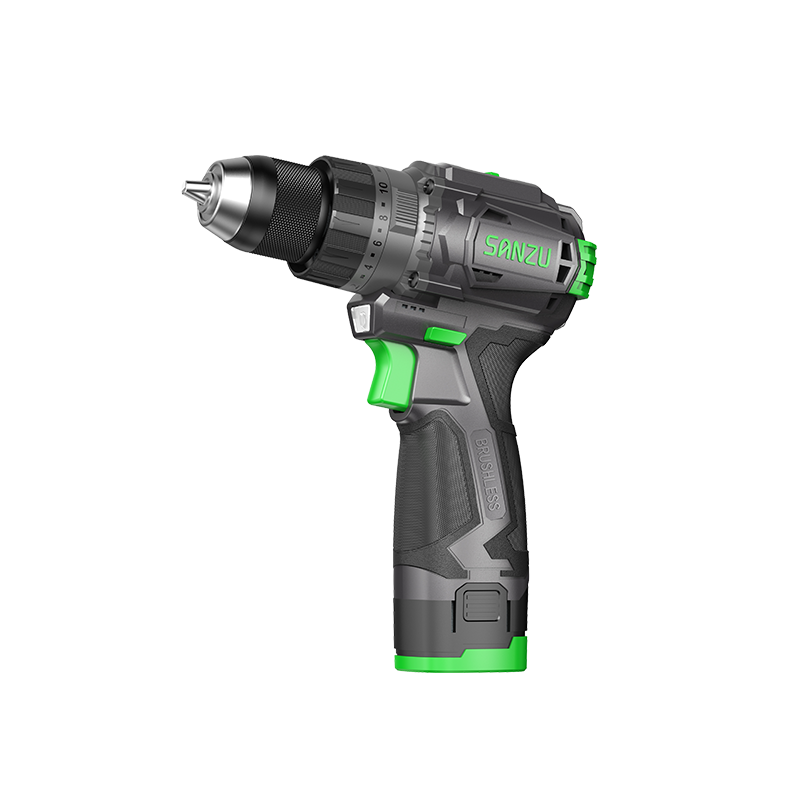
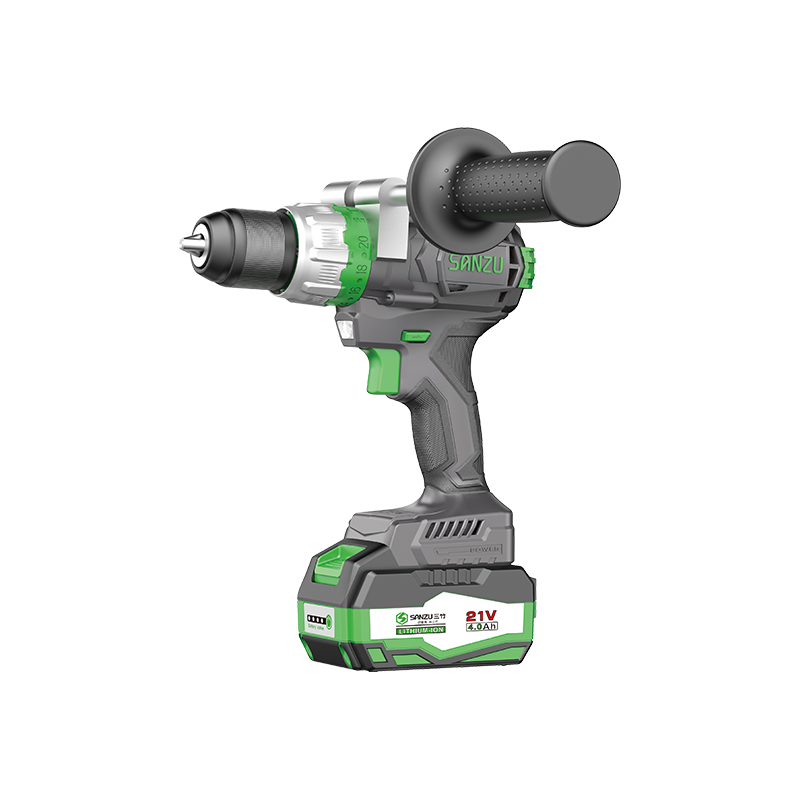
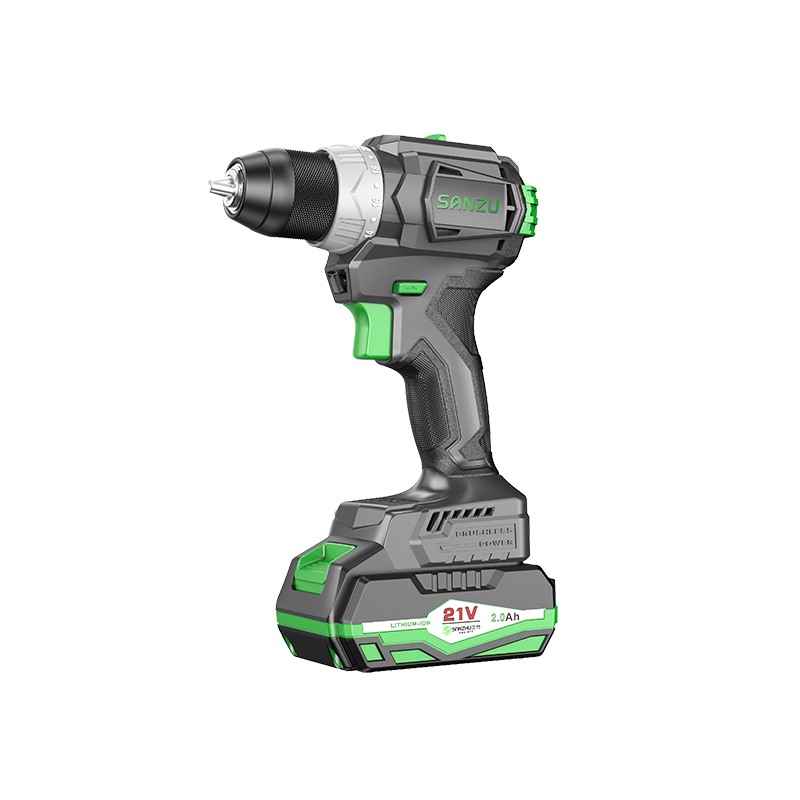 SANZU Compact Brushless Drill with Strong TorqueA 21 V, 45 N·m compact brushless drill for wood, metal and plastic, suited to light drilling while dedicated tools handle concrete or large hardwood bits.View Product →
The decision rule here is simple. If the largest bit in regular use is over 25 mm in hardwood, or the material is concrete above 8 mm, buy the correct tool for that job and keep the brushless drill for everything else. A compact drill pushed beyond its torque band fails at the gearbox, and gearbox repairs rarely make economic sense.
A Practical Buying Checklist
Before signing off a purchase, run through these eight points. Each one has caught out a purchase at some point.
- Confirm the motor is brushless at the rotor. A label is not proof; ask for a section drawing or an internal photo showing magnets on the rotor and windings on the stator.
- Check torque at the chuck, not at the motor. Ask whether the figure is peak motor torque or sustained output torque, and at what speed.
- Identify the cells. 21700 cells generally deliver more current and heat tolerance than 18650 cells at the same capacity, which shows up in long sessions rather than in the brochure.
- Confirm the controller protections: over-temperature, over-discharge, over-current, and soft start. Missing protections shorten tool life far more than a lower torque rating does.
- Spin the chuck with a bit fitted and check runout. Anything above 0.5 mm visible wobble is a reject.
- Ask for spare parts availability on the switch, controller and chuck. A tool with no parts on the shelf has a fixed service life regardless of motor type.
- Verify the paperwork: CE or UKCA for Europe, ETL or UL for North America, UN38.3 for battery transport, and a test report that matches the model number on the label.
- Read the warranty terms for what is excluded. Controllers and packs are often excluded from long warranties, which is exactly where failures cluster.
What Fails First, and How to Make a Drill Last
Across service returns, the failure order is consistent: trigger switch, chuck jaws, controller board, battery management board, then gearbox. The motor itself is rarely the cause on either type, which is an argument for buying a tool with a good switch and a well-cooled controller rather than chasing the highest torque number.
Three habits extend life noticeably. Blow the vents out weekly instead of annually, because dust blocks the airflow path around the controller. Do not store packs at full charge in a hot vehicle, since heat plus full charge is the fastest way to lose capacity. And let the tool cool between long runs; five minutes of idle time between sessions costs less than one controller replacement.
Questions Buyers Ask Before Choosing
Is a brushless drill worth it for home use?
Usually not on efficiency grounds. A household that drills fifty holes a year will never recover the price difference through battery savings. It can still be worth it for comfort and control, since a brushless drill is lighter at the nose, quieter and easier to start accurately, and those benefits appear on the first hole rather than the thousandth.
How much longer does a brushless drill actually last?
Roughly twice as long in daily professional use, provided the controller is well protected. The motor itself will outlast the tool. The realistic limit is the electronics, the switch and the gearbox, so a brushless drill with a cheap controller can fail sooner than a well-built brushed model.
Do brushless drills produce more torque?
They usually produce the same or slightly higher peak torque, and noticeably more torque under sustained load. The second part matters more. A brushed drill rated at 55 N·m may hold only 35 N·m when a hole saw bites, while a brushless drill at the same rating holds close to 50 N·m.
Can brushes be replaced with a brushless motor?
No. The two designs use different rotors, different housings and completely different control electronics. Conversion is not a service operation; it is a new tool.
Is brushless better for masonry work?
Only within limits. Brushless efficiency helps in hammer mode, but impact energy decides performance in concrete, and a drill in hammer mode cannot match a dedicated rotary hammer above 8 mm. Choose by impact energy, not by motor type.
Do brushless drills need special batteries?
They need packs with a management board that can handle higher current spikes, and they benefit from packs built with cells rated for continuous discharge. Any pack from the same platform that meets those conditions will work; the voltage label alone tells you nothing.
Are brushless drills quieter?
Yes, typically 3 to 6 dB at the operator, mostly because there is no brush arcing. The gearbox and the load noise remain, so hearing protection is still required in enclosed spaces.
Is 16 V or 20 V the better platform for a brushless drill?
A 16 V platform is lighter and adequate for assembly, fitting and light drilling up to 8 mm. A 20 V platform carries more energy per pack and handles hole saws and larger bits without stalling. For mixed site work, 20 V is the safer single-platform choice.
The Number to Check Before You Decide
Do the payback test with your own figures rather than a brochure. Divide the price difference between the brushed and brushless versions by the annual saving from fewer battery cycles, fewer replacements and any labour time recovered from fewer battery swaps. If the result is under 18 months and the tool will be used for four years or more, the brushless drill is worth it. If the result runs past three years, buy the brushed tool, put the difference into a second battery and a better charger, and revisit the decision when the platform changes.

 English
 русский
 Español